Bible Verses for Retirement: Scripture for This New Chapter
Bible verses for retirement — grouped by theme, with Hebrew and Greek context. Scripture for finishing well, resting, and finding purpose.
Contents
The word “retirement” appears nowhere in the Bible. Not once. The concept — a fixed moment when labor stops and a different kind of life begins — is a twentieth-century invention, born from the 1935 Social Security Act. For the entire biblical world, people worked until their bodies couldn’t. There was no gold watch. No farewell party.
That doesn’t mean Scripture has nothing to say. The bible verses for retirement collected here speak to it differently — not as a finish line, but as a threshold. They don’t address retirement as Americans invented it. They address what retirement actually is: the end of one chapter’s labor, the weight of accumulated years, the legitimacy of rest, the question of what comes next, and the discovery that the later seasons of life carry a depth the earlier ones couldn’t.
Finishing the Race Well
2 Timothy 4:7 — I Have Kept the Faith
“I have fought the good fight, I have finished the race, I have kept the faith.” — 2 Timothy 4:7 (NIV)
Paul wrote these words in his final letter, from a Roman prison, knowing he was about to be executed. Second Timothy is a farewell. The man who planted churches across the Mediterranean, survived shipwrecks, stonings, and years of imprisonment, reduces his entire life to three clauses. Not “I built an empire.” Not “I accomplished my goals.” I fought. I finished. I kept.
The Greek agon — translated “good fight” — refers to a public athletic contest, deliberate effort sustained against real opposition over time. And kalos (good) means beautiful, honorable, excellent in quality. Paul isn’t claiming he never lost or never suffered. He’s claiming the effort itself was the right kind. The word dromos — “race” — literally means a running track. Teteleka ton dromon: I have completed the track. Not “I finished fast.” Not “I finished first.” Completed. The full distance.
For someone entering retirement, this verse names what most people never hear named: the faithfulness of a full course run. Not heroic. Not famous. Complete. Most people retire not as legends but as faithful ones — people who showed up, did the work, kept their word, raised their families. Second Timothy 4:7 says that is worth saying out loud.
Psalm 92:14 — Still Bearing Fruit
“They will still bear fruit in old age, they will stay fresh and green.” — Psalm 92:14 (NIV)
Psalm 92 is the only psalm with a specific liturgical designation: “A Song for the Sabbath Day.” The Sabbath psalm — about rest and continued life. The Hebrew root dashen means fat, rich, full of sap, the language used elsewhere for a well-watered garden. And ra’anan — “fresh and green” — describes a tree with living sap still running through it. The image is biological and deliberate. Old wood is not dead wood. Sap still moves.
This verse exists for the person who fears that retirement means becoming irrelevant. The psalmist identifies fruit-bearing and flourishing as specifically descriptive of the aged — not in spite of their years, but within them. For verses concise enough to inscribe in a retirement card, short bible verses has options that carry real weight in a single line.
Rest After Labor
Matthew 11:28 — Come to Me, All Who Are Weary
“Come to me, all you who are weary and burdened, and I will give you rest.” — Matthew 11:28 (NIV)
Jesus spoke this to a crowd of ordinary people in Roman-occupied Palestine — laborers, farmers, tradespeople whose lives were defined by physical work, religious obligation, and imperial taxation. The Greek kopiaō — “weary” — describes exhaustion from sustained, repetitive labor. Not a bad day. Decades of it. And anapausis — “rest” — means a deliberate cessation of labor. In classical Greek the word was used for military troops being stood down from active duty. The rest Jesus offers isn’t distraction or entertainment. It’s the real thing. Ceasing.
For someone who has worked thirty or forty years, this verse lands differently than it does for a twenty-five-year-old. Jesus isn’t promising that rest is something you eventually earn. He’s saying it is something He gives. The invitation is open — and retirement is one of the legitimate places it can be received.
Psalm 23:2-3 — Green Pastures, Quiet Waters
“He makes me lie down in green pastures, he leads me beside quiet waters, he refreshes my soul.” — Psalm 23:2-3 (NIV)
David wrote this — a former shepherd writing about what it means to be led rather than to lead. A shepherd knows the flock needs rest before the flock does. David understood that from experience.
The Hebrew menuha — the “quiet” of “quiet waters” — literally means a resting place, stillness, a stopping point from movement. The same word is used for the Promised Land as Israel’s ultimate destination of rest in Psalm 95:11. Rest in David’s vocabulary is not a reward at the end. It is the destination itself. And yeshavev nafshi — “refreshes my soul” — means restores, turns back, returns to the right path. The soul that has been pushed long and far is brought back to itself.
The Psalms are often read at funerals. Psalm 23 belongs equally at retirements. Both are thresholds where a long journey changes form.

Many people mark retirement with something that lasts — a gift the retiree sees every day in the new season. These four are chosen for someone whose faith has shaped their working life and will shape what comes next.
Meaningful Retirement Gifts

3D Crystal Christian Gift with LED Light Base
3D crystal with Bible verse and LED base — a distinctive gift that catches the light.
Check Price on AmazonAs an affiliate, we earn on qualifying purchases.
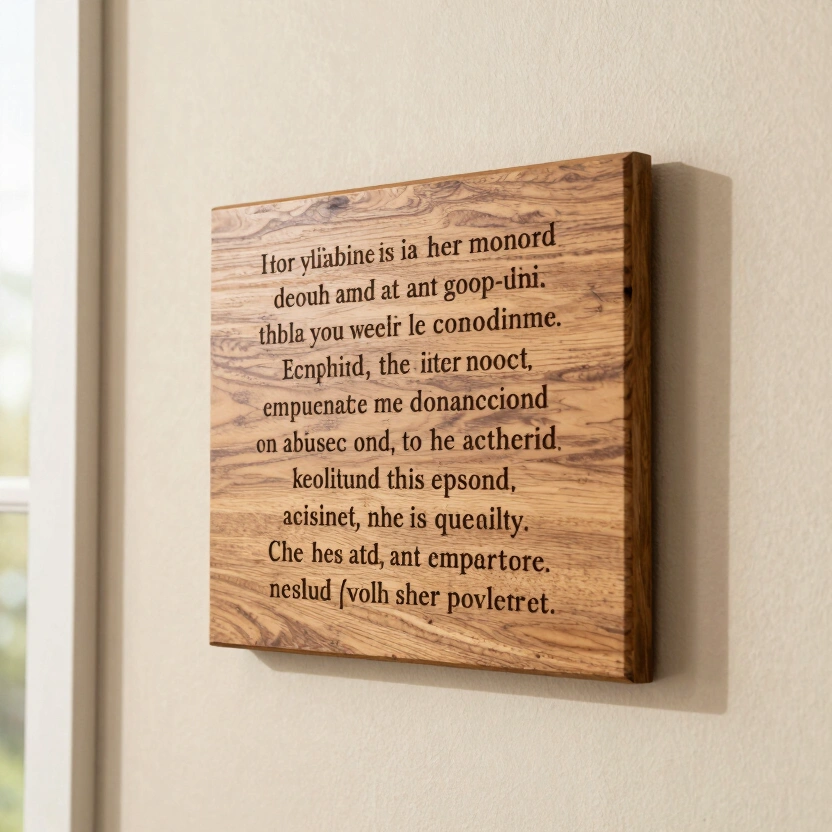
OAK Wood Identity in Christ Wall Art
Handcrafted oak wood wall art featuring Identity in Christ Scripture references.
Check Price on AmazonAs an affiliate, we earn on qualifying purchases.

All Things Work Together for Good Romans 8:28 Framed Wall Art
Large framed canvas featuring Romans 8:28 'All Things Work Together for Good' in modern typography.
Check Price on AmazonAs an affiliate, we earn on qualifying purchases.
Wisdom in Later Years
Proverbs 16:31 — Gray Hair as a Crown
“Gray hair is a crown of splendor; it is attained in the way of righteousness.” — Proverbs 16:31 (NIV)
Solomon’s Proverbs treat visible aging the opposite of how Western culture treats it. The Hebrew tif’eret — “crown of splendor” — means beauty, glory, ornament. The same word appears in Proverbs 17:6 where grandchildren are called “crowns.” Gray hair isn’t deterioration to manage. It is an ornament to wear. And the qualification matters: “attained in the way of righteousness.” The crown belongs to the life that was lived with faithfulness. For a retiree who has done that, the verse names it publicly.
Proverbs 3:5-6 — Trust Beyond Your Own Understanding
“Trust in the Lord with all your heart and lean not on your own understanding; in all your ways submit to him, and he will make your paths straight.” — Proverbs 3:5-6 (NIV)
Solomon addressed this to “my son” — instruction from the experienced to the beginning. But the verse carries equal weight spoken the other direction: to someone who has lived long enough to accumulate significant experience and must now resist the temptation to rely entirely on that experience.
The Hebrew batach — “trust” — means to set your full weight on something, to depend completely. And “lean not on your own understanding” uses a related root: don’t put your weight on your own framework. The command is not to distrust experience. It’s to hold it loosely enough to keep following. Yeyasher — “make your paths straight” — means directed, aligned, purposeful. Not obstacle-free. Directionally clear.
Retirement often produces a crisis of expertise: for decades, you knew what to do. Suddenly the structure is gone. Proverbs 3:5-6 speaks to that specific disorientation — trust that holds through the threshold where your old maps no longer apply. For a broader look at what the Bible says about wisdom in practice, bible verses about wisdom covers the full breadth of what Proverbs and James teach.
Job 12:12 — Long Life Brings Understanding
“Is not wisdom found among the aged? Does not long life bring understanding?” — Job 12:12 (NIV)
Job’s friend Bildad had been lecturing him with tidy theological answers. Job pushes back — not denying that wisdom accrues with age, but insisting that age alone doesn’t confer the right to speak for God. Verse 13 gives the larger frame: “To God belong wisdom and power.” The wisdom of the aged is real, but it is derivative. It came from somewhere.
The Hebrew chokmah — wisdom — is practical skill in living, from the same root as the word for the artisan who crafted the tabernacle furnishings. Wisdom is craft knowledge applied to life. The retiree carries something no credential conveyed and no degree granted: the pattern-recognition that comes from decades of actual living. Job names that as real and worthy of the word “wisdom.”
Scripture for Retirement: A New Purpose
Jeremiah 29:11 — Plans for a Future
“‘For I know the plans I have for you,’ declares the Lord, ‘plans to prosper you and not to harm you, plans to give you hope and a future.’” — Jeremiah 29:11 (NIV)
This is the most quoted verse at graduation ceremonies — and the most misapplied. God said this to Israelite exiles in Babylon. Not twenty-two-year-olds. People in their sixties and older who had been displaced from their homeland and would not live to see the return. The original recipients were past their prime institutional usefulness, and God told them they still had a future. The Hebrew acharit — “future” — means the final destination, the endpoint of a long trajectory. Not next year’s plans. The shape of the whole thing.
For someone entering retirement, this verse may actually land more accurately than it does at a commencement ceremony. The feelings are closer: displacement, uncertainty, the question of what’s left. The promise is the same: the arc of your life has a destination, and God knows what it is. When you’re ready to explore this theme further, bible verses about new beginnings gathers the full range of Scripture for thresholds like this one.
Isaiah 46:4 — I Will Carry You
“Even to your old age and gray hairs I am he, I am he who will sustain you. I have made you and I will carry you; I will sustain you and I will rescue you.” — Isaiah 46:4 (NIV)
God speaks to Israel, comparing Himself to the pagan gods of Babylon — statues so heavy they had to be hauled around on oxen. Those gods need carrying. Israel’s God does the carrying. And the carrying extends explicitly to old age. The Hebrew siyvah means gray-haired, hoary — the same visual marker as Proverbs 16:31. God names the gray-hair season specifically and claims it.
Four verbs, all first-person, all active: made you, carry you, sustain you, rescue you. The initiative is entirely God’s. For people trained by decades of productivity, the hardest spiritual discipline of later life may be receiving rather than performing. This verse describes a God who doesn’t wait to be asked. He acts.
Ecclesiastes 3:1 — A Season for Every Activity
“There is a time for everything, and a season for every activity under the heavens.” — Ecclesiastes 3:1 (NIV)
The Teacher observes the rhythm of existence — birth and death, planting and uprooting, weeping and laughing. The Hebrew zeman means an appointed time, a fixed period with its own designated purpose. Not an accident. Not a gap between real seasons. An appointed span.
Retirement is a zeman — not an ending but a season with its own character, its own things to plant and harvest. The verse doesn’t say “a time for everything except the final third of your life.” It says everything. This one counts too.

Retirement doesn’t appear in the Bible by name. But the experiences it produces — the weight of years carried faithfully, the legitimacy of rest after long labor, the accumulated wisdom that age earns, the question of what comes next — all of those appear, often and with depth. These bible verses for retirement don’t offer a roadmap for the season. They offer what the Bible usually offers: company in it. A framework for reading it as something other than an ending.
For verses concise enough to write in a retirement card, short bible verses has options that hold real weight in a single line.
Frequently Asked Questions
What is a good Bible verse for retirement?
2 Timothy 4:7 — “I have fought the good fight, I have finished the race, I have kept the faith.” Paul’s final words honor completion and faithfulness without requiring heroism. The Greek dromos (race) means the full distance of the track — completed, not won. Psalm 92:14 — “They will still bear fruit in old age” — works equally well for someone stepping into a new season of contribution rather than withdrawal.
What does the Bible say about retirement?
The Bible doesn’t address retirement directly — the concept didn’t exist in the ancient world. But it speaks to everything retirement involves: the legitimacy of rest after sustained labor (Matthew 11:28), the honor of accumulated age (Proverbs 16:31), the continuity of God’s presence into old age (Isaiah 46:4), and the reality that every life has appointed seasons with distinct purposes (Ecclesiastes 3:1). The bible verses for retirement in this article gather those threads into one place.
What Scripture verse is about finishing well?
2 Timothy 4:7 is Paul’s own statement about finishing well — written from prison as his final letter before execution. The three clauses address effort (agon — the contest), endurance (dromos — the full track), and faithfulness (pistin — the faith held to the end). Hebrews 12:1 adds the communal dimension: “Let us run with perseverance the race marked out for us” — finishing well alongside the witnesses who ran before you.
What Bible verse is about a new chapter in life?
Jeremiah 29:11 — “plans to give you hope and a future” — was originally spoken to displaced elders in Babylon, making it more appropriate for retirement than most people realize. Isaiah 43:19 — “I am doing a new thing; now it springs up; do you not perceive it?” — speaks directly to unprecedented new seasons. Both treat the new chapter as purposeful, not incidental. The Hebrew acharit in Jeremiah means the endpoint of the entire arc — not just next month’s plans.
Related Articles

Bible Verses for Baby Dedication and Blessing
The best Bible verses for baby dedication — what each verse meant in its original context, which ones work for ceremonies, and how to choose the right verse for the child you're blessing.

Proverbs 3:5-6 Meaning: Trust in the Lord With All Your Heart
Proverbs 3:5-6 is the most quoted trust verse in the Bible — but the Hebrew reveals something the English doesn't. Here's what 'lean not on your own understanding' actually means, who Solomon was, and why this verse works differently than you think.

Bible Verses About Trust When Everything Feels Uncertain
These bible verses about trust were written by people who had real reasons not to trust — exiles, prisoners, kings running for their lives. Here's the history and language behind each one.