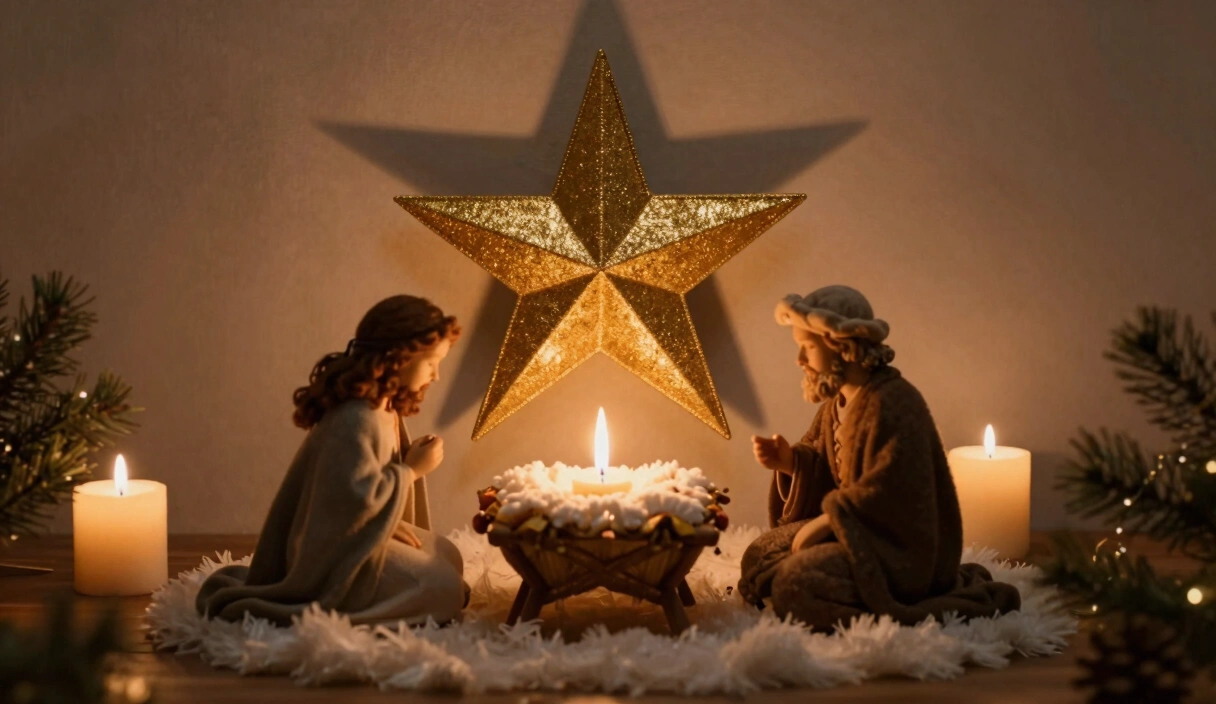
Bible Verses for Christmas: The True Story Behind the Holiday
15 bible verses for christmas — not just the familiar passages, but the prophecies, the backstories, and the details most people skip over in the nativity.
Contents
The Christmas story in the Bible is stranger than the version most people know. There’s no innkeeper. The text never says there were three wise men — it says “magi from the east” without a number. The star they followed may have been a planetary conjunction. And the whole thing — all of it — was set in motion not by a decree from heaven but by a Roman tax census. God used an emperor’s bureaucracy to get a pregnant teenager to the right town at the right time.
These bible verses for christmas are the actual story — the prophecies that set it up centuries in advance, the birth narratives from Matthew and Luke, and the passages that explain why it matters beyond December 25th.
The Prophecies: Centuries Before Bethlehem
Isaiah 7:14
“Therefore the Lord himself will give you a sign: The virgin will conceive and give birth to a son, and will call him Immanuel.”
Isaiah wrote this around 735 BCE — over seven hundred years before Jesus was born. The Hebrew word almah means a young woman of marriageable age. The Greek Septuagint translated it parthenos — virgin. That translation choice became one of the most debated words in biblical history. Matthew quoted it in Greek and applied it directly to Mary (Matthew 1:23). The name Immanuel means “God with us” — not God watching us, not God above us. With.
Micah 5:2
“But you, Bethlehem Ephrathah, though you are small among the clans of Judah, out of you will come for me one who will be ruler over Israel, whose origins are from of old, from ancient times.”
Micah, writing around 700 BCE, naming the exact town. Bethlehem was tiny — a village, not a city. And Micah adds “whose origins are from of old” — the Hebrew qedem implies the distant past, even eternity. The ruler coming from this insignificant village has origins that predate the village itself. Matthew’s magi were directed to Bethlehem because the chief priests knew this verse by heart (Matthew 2:5-6).
Isaiah 9:6
“For to us a child is born, to us a son is given, and the government will be on his shoulders. And he will be called Wonderful Counselor, Mighty God, Everlasting Father, Prince of Peace.”
Four titles packed into one verse. Pele Yoetz — Wonderful Counselor, a strategist beyond comprehension. El Gibbor — Mighty God, a title reserved for deity. Avi Ad — Everlasting Father, a parent whose care doesn’t expire. Sar Shalom — Prince of Peace, a ruler whose kingdom runs on wholeness. This verse is read in churches every December, but Isaiah wrote it during one of Israel’s darkest political periods — the Assyrian threat. The hope was born out of crisis, not celebration.
The Birth: What Luke and Matthew Actually Wrote
Luke 2:4-7
“So Joseph also went up from the town of Nazareth in Galilee to Judea, to Bethlehem the town of David, because he belonged to the house and line of David. He went there to register with Mary, who was pledged to be married to him and was expecting a child. While they were there, the time came for the baby to be born, and she gave birth to her firstborn, a son. She wrapped him in cloths and placed him in a manger, because there was no guest room available for them.”
The word translated “inn” in older versions — kataluma in Greek — actually means “guest room.” The same word describes the upper room where Jesus later ate the Last Supper. Luke didn’t say “hotel.” He said the family guest room in a relative’s house was already occupied. The manger — a feeding trough — was likely in the lower level of a typical Palestinian home where animals were kept at night. Not a stable behind an inn. A house. The poverty is real. The isolation isn’t quite what the nativity scene suggests.
Luke 2:8-12
“And there were shepherds living out in the fields nearby, keeping watch over their flocks at night. An angel of the Lord appeared to them, and the glory of the Lord shone around them, and they were terrified. But the angel said to them, ‘Do not be afraid. I bring you good news that will cause great joy for all the people. Today in the town of David a Savior has been born to you; he is the Messiah, the Lord. This will be a sign to you: You will find a baby wrapped in cloths and lying in a manger.’”
The announcement went to shepherds — not to priests, not to scholars, not to the powerful. Shepherds in first-century Palestine were near the bottom of the social hierarchy. Their testimony wasn’t even admissible in court. God chose unreliable witnesses for the most important birth announcement in history. The word “terrified” — phobeo — means they were seized with fear. The glory — doxa — was visible, physical, overwhelming. And the sign God gave wasn’t a star or a miracle. It was a baby in a feeding trough. The humility is the message.
Matthew 1:20-21
“But after he had considered this, an angel of the Lord appeared to him in a dream and said, ‘Joseph son of David, do not be afraid to take Mary home as your wife, because what is conceived in her is from the Holy Spirit. She will give birth to a son, and you are to give him the name Jesus, because he will save his people from their sins.’”
Matthew tells the story from Joseph’s side. He was going to divorce Mary quietly — the Greek deigmatisai suggests he wanted to avoid public humiliation for her. He was a decent man in an impossible situation. The angel’s instruction: name him Yeshua — which means “the Lord saves.” Every time anyone called Jesus by name, they were saying a sentence: God rescues.
Recommended Resources

All Things Work Together for Good Romans 8:28 Framed Wall Art
Large framed canvas featuring Romans 8:28 'All Things Work Together for Good' in modern typography.
Check Price on AmazonAs an affiliate, we earn on qualifying purchases.

NIV Beautiful Word Bible
Full-color illustrated Bible with 500+ hand-lettered verses for creative journaling and reflection.
Check Price on AmazonAs an affiliate, we earn on qualifying purchases.

XKDOUS Bible Verses Jar Kit — 270 Selected Verses
Jar with 270 hand-selected Bible verses for daily encouragement — ideal as a Christian graduation or friendship gift.
Check Price on AmazonAs an affiliate, we earn on qualifying purchases.
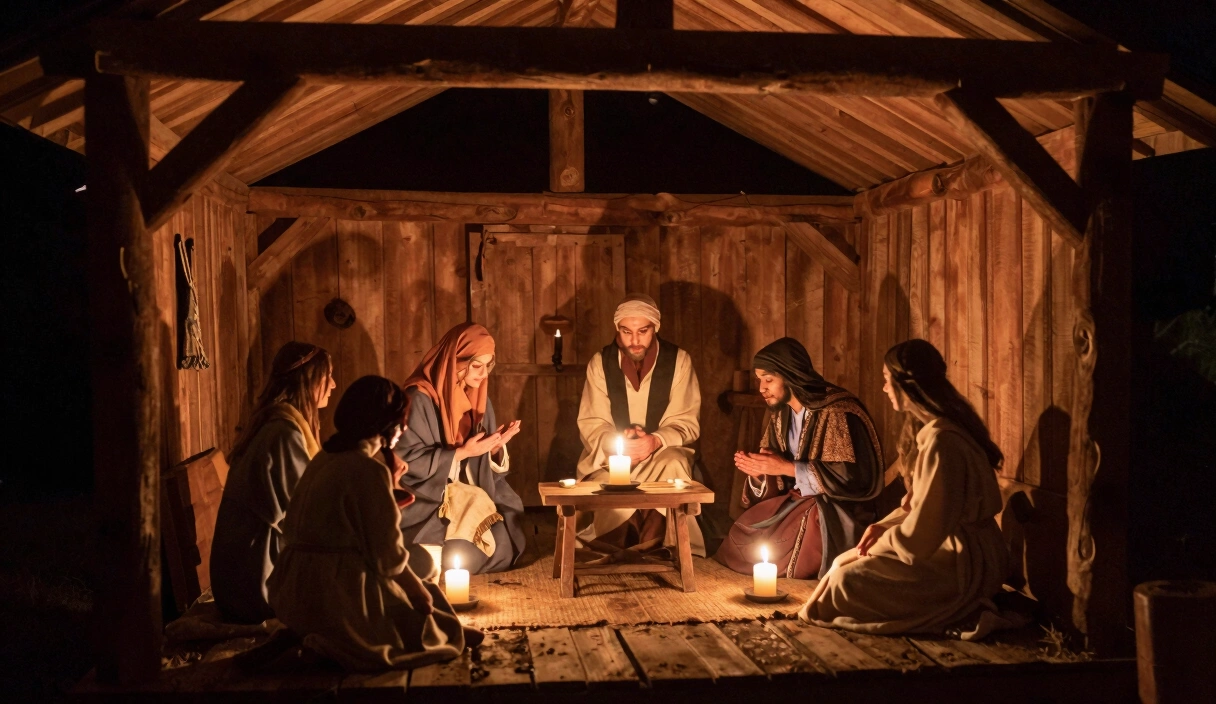
The Deeper Christmas Verses Most People Miss
John 1:14
“The Word became flesh and made his dwelling among us. We have seen his glory, the glory of the one and only Son, who came from the Father, full of grace and truth.”
John’s Christmas story has no manger, no shepherds, no star. It has this: the Logos — the organizing principle of the universe, the Word that spoke creation into existence — became a human body and moved into the neighborhood. “Made his dwelling” translates skenoo — literally “pitched a tent.” The God of the cosmos became a camper. John 1:14 is the theological explanation for what Luke and Matthew describe as history. For the full breakdown of John’s theology, the verse-meaning article goes deeper.
Galatians 4:4-5
“But when the set time had fully come, God sent his Son, born of a woman, born under the law, to redeem those under the law, that we might receive adoption to sonship.”
Paul’s only direct reference to Christmas — and it has no narrative detail at all. Just theology compressed into two verses. “When the set time had fully come” — pleroma tou chronou — the fullness of time. Paul believed the timing was precise: the Roman road system, the common Greek language, the political stability of the Pax Romana — all of it infrastructure for a message that needed to travel fast and far. The birth wasn’t accidental. It was scheduled.
Philippians 2:6-7
“Who, being in very nature God, did not consider equality with God something to be used to his own advantage; rather, he made himself nothing by taking the very nature of a servant, being made in human likeness.”
Paul describing what Christmas cost God. The Greek kenosis — “made himself nothing” — means to empty, to pour out. Not to stop being God. To voluntarily set aside the advantages of divinity. A king who becomes a servant while remaining a king. That’s the theological engine behind the manger: not a powerful God who sent someone else, but a God who came himself, unarmed, unrecognized, and born into poverty.
Luke 2:29-32
“Sovereign Lord, as you have promised, you may now dismiss your servant in peace. For my eyes have seen your salvation, which you have prepared in the sight of all nations: a light for revelation to the Gentiles, and the glory of your people Israel.”
Simeon — an old man in the temple — holding a six-week-old baby and saying he could die now because he’d seen what he’d been waiting for. The phrase “a light for revelation to the Gentiles” was radical. This wasn’t just Israel’s Messiah. This child was for everyone. Simeon also told Mary: “A sword will pierce your own soul too” (Luke 2:35). The Christmas story in the temple already carried the shadow of the cross.
The Christmas story isn’t a children’s tale. It’s a story about an empire’s census, a teenage mother, a man who almost walked away, shepherds nobody believed, scholars who followed a star for months, and a king who tried to murder every baby in a town. The glory of it sits right next to the danger. That’s what makes it matter beyond December.
For more on the verses that made their way from Scripture into cultural tradition, most popular Bible verses traces how passages like John 3:16 and Isaiah 9:6 became household quotes. And if you’re looking for shorter passages to include in a card or gift, the short verses collection has several from this list.

Related Articles
Frequently Asked Questions
What is the main Bible verse for Christmas?
Luke 2:10-11 — “I bring you good news that will cause great joy for all the people. Today in the town of David a Savior has been born to you” — is the most directly narrative Christmas verse. John 1:14 — “The Word became flesh and made his dwelling among us” — is the most theologically significant. Isaiah 9:6 is the most read at Christmas services. All three approach the same event from different angles: the announcement, the meaning, and the prophecy.
What does the Bible actually say about the Christmas story?
Two Gospels tell the birth narrative. Luke provides Mary’s perspective: the angel Gabriel, the journey to Bethlehem, the shepherds, the manger. Matthew provides Joseph’s perspective: the dream, the magi, the flight to Egypt, Herod’s massacre. Mark and John don’t include birth stories — Mark starts at Jesus’ baptism, John starts at creation (“In the beginning was the Word”). Paul references the birth only theologically (Galatians 4:4-5), never narratively.
Were there really three wise men?
The Bible doesn’t say three. Matthew 2:1 says “magi from the east” — no number given. The tradition of three comes from the three gifts mentioned: gold, frankincense, and myrrh. They weren’t kings — magoi were likely Zoroastrian priest-astronomers from Persia or Babylon. And they didn’t arrive at the manger. Matthew says they visited a “house” (Matthew 2:11) and that Jesus was a “child” (paidion), not a newborn (brephos). They may have arrived months or even up to two years after the birth.
Related Articles

Bible Verses About Love: 18 Scriptures With Context and Meaning
These 18 Bible verses about love come with the context, history, and meaning behind each one — so the words actually reach you where you are.
Most Popular Bible Verses: Why These 15 Scriptures Became Famous
The 15 most popular bible verses of all time — not just listed, but explained: how they became famous, what they originally meant, and why they still matter.

Bible Verses for Birthdays: 12 Scriptures of Blessing and Gratitude
12 bible verses for birthdays — for cards, prayers, and toasts. Each verse with its original context and why it works for celebrating another year of life.