
Bible Verses About Doubt When Your Faith Feels Thin
Bible verses about doubt — the Greek diakrino vs apistia distinction, the Psalms as structured doubt, and what Jesus did when Thomas asked for proof.
Contents
It is three in the morning and the house is quiet except for the refrigerator hum and the sound of your own breathing. You are awake. Not because of noise or pain — because of a question. One that has been sitting in the back of your mind for weeks, maybe longer, and tonight it will not be polite enough to wait until daylight. The question is simple and enormous: What if none of this is real?
If that is what brought you here — or something close to it — these bible verses about doubt were written by people who felt exactly what you feel. Not as a hypothetical. As a lived experience that threatened to undo them.
What the Bible Actually Says About Doubt
Two Greek words, two different conditions.
Diakrino (διακρίνω) — the New Testament’s most common word for doubt. It means, literally, to judge in two directions simultaneously. To hold two possibilities and not know which one is true. A person experiencing diakrino has not rejected God. They are standing between two realities, unable to settle. James uses this word. So does Paul. It is the doubt of someone still in the room, still asking.
Apistia (ἀπιστία) — a different and harder word. Unbelief. Active rejection. Not wavering between two options but turning away from one entirely. The New Testament uses different vocabulary for these two states because it treats them as different conditions. The person searching for bible verses about doubt at three in the morning is almost certainly experiencing diakrino — and that matters, because the Bible responds to it differently than most people expect.
The Psalms, for instance, are structurally built on doubt. The lament psalms — and there are more laments than any other psalm type — begin with complaint and confusion, not resolution. The form itself validates the experience before it resolves it.
Honest Cries in the Psalms — When Doubt Sounds Like Prayer
Psalm 13:1-2 — How Long, Lord?
“How long, Lord? Will you forget me forever? How long will you hide your face from me? How long must I wrestle with my thoughts and day after day have sorrow in my heart?” — Psalm 13:1-2 (NIV)
David wrote this. Not a spiritual novice — the man God described as “a man after my own heart” (Acts 13:22). And yet four consecutive “how long” questions open this psalm. No answer first. No theological qualification. Just the raw weight of a man who cannot feel the God he knows is there.
The likely context is the years David spent hunted by Saul — years of hiding in caves, sleeping in deserts, watching promises evaporate into silence. The word translated “wrestle” in verse 2 carries the sense of placing a burden down and picking it back up, endlessly. David is describing the repetitive weight of unresolved thoughts.
But Psalm 13’s structure matters as much as its content. It begins with complaint (verses 1-2), moves to petition (verses 3-4), and ends with trust (verses 5-6). The doubt is the starting point. Not the conclusion.
Psalm 77:1-3, 7-9 — Has God Forgotten to Be Gracious?
“I cried out to God for help… my soul refused to be comforted… Has God forgotten to be gracious? Has he in anger withheld his compassion?” — Psalm 77:1-3, 7-9 (NIV)
Asaph was a worship leader. The irony should stop you: the man writing songs for congregational worship is the man asking whether God has forgotten to be kind. Bible verses about faith gather the passages where belief holds firm — Psalm 77 is what it looks like when belief buckles.
The psalm turns at verse 10. “I will remember the deeds of the Lord.” Asaph’s resolution does not come from the doubt evaporating. It comes from the deliberate act of remembering what he already knew. When you cannot feel God, Asaph’s prescription was not to feel harder. It was to remember.
Psalm 42:5 rounds out this pattern — “Why, my soul, are you downcast? Why so disturbed within me?” The sons of Korah who wrote it were temple musicians cut off from the sanctuary during exile. Their doubt was geographic and spiritual displacement at the same time. The psalm talks to itself, argues with its own despair.
The Verses That Name Doubt Directly
Mark 9:24 — The Most Honest Prayer in Scripture
“Immediately the boy’s father exclaimed, ‘I do believe; help me overcome my unbelief!’” — Mark 9:24 (NIV)
This verse has carried more people through crisis than almost any other line about doubt in the Bible. And the context makes it heavier.
The father has brought his son — convulsing, unable to speak, thrown into fire and water by a spirit — to Jesus’ disciples. They failed. The father has now come to Jesus directly, and what he says is not a theological formulation. It is a real-time confession spoken while his child is suffering in front of him: I believe and I do not believe, simultaneously. Both at once.
“Unbelief” here is apistia — the stronger word. But the man is not claiming settled unbelief. He is confessing a mixture. He is holding diakrino and apistia in the same breath and bringing both of them to Jesus. And Jesus does not rebuke the mixture. He heals the boy.
In Mark’s structure, this scene follows immediately after the Transfiguration — moments after Peter, James, and John witnessed Jesus in full glory on the mountaintop, the disciples at the base of the mountain had failed to help a suffering child. The juxtaposition is intentional. Mountain-top revelation and valley-level failure in the same chapter.
This verse asks nothing of the doubter except honesty. Not resolved belief. Not theological clarity. Just the direction of your face.
James 1:5-6 — The Most Misread Verse About Doubt
“If any of you lacks wisdom, you should ask God, who gives generously to all without finding fault, and it will be given to you. But when you ask, you must believe and not doubt, because the one who doubts is like a wave of the sea, blown and tossed by the wind.” — James 1:5-6 (NIV)
This is the verse most people have used against doubters. And it is the verse most worth rehabilitating.
James — widely held to be Jesus’ brother — spent years in the same house as Jesus and did not believe during the ministry period (John 7:5). He came to faith after the resurrection. This is not a man writing about doubt from a distance.
The critical context: James 1:5-6 is specifically about asking God for wisdom when facing trials. It is not a blanket condemnation of anyone who has ever doubted anything. The “wave” image describes double-mindedness in the specific act of petitioning God for guidance — asking while simultaneously refusing to trust the answer. That is a narrower instruction than the way it is usually preached.
The Greek diakrino in verse 6 is the same “judge in two directions” word from the frame above. James is naming a posture in prayer, not issuing a verdict on the emotional experience of doubt. If anyone has ever wielded this verse against you like a closed door, the bible verses about trust offer the counterpoint James himself would recognize.
Matthew 21:21 belongs nearby — “if you have faith and do not doubt, you can say to this mountain, ‘Go, throw yourself into the sea.’” Said after the fig tree withered. A hyperbolic teaching device about the relational posture of trust, not a test of cognitive certainty. Mountains do not literally move. But the person who prays without hedging discovers something about the God they are praying to.
If you are in a season where doubt has been sitting on you for longer than you expected, these books have been companions for a lot of readers in exactly that place — not as fixes, but as company.
When Faith Feels Thin
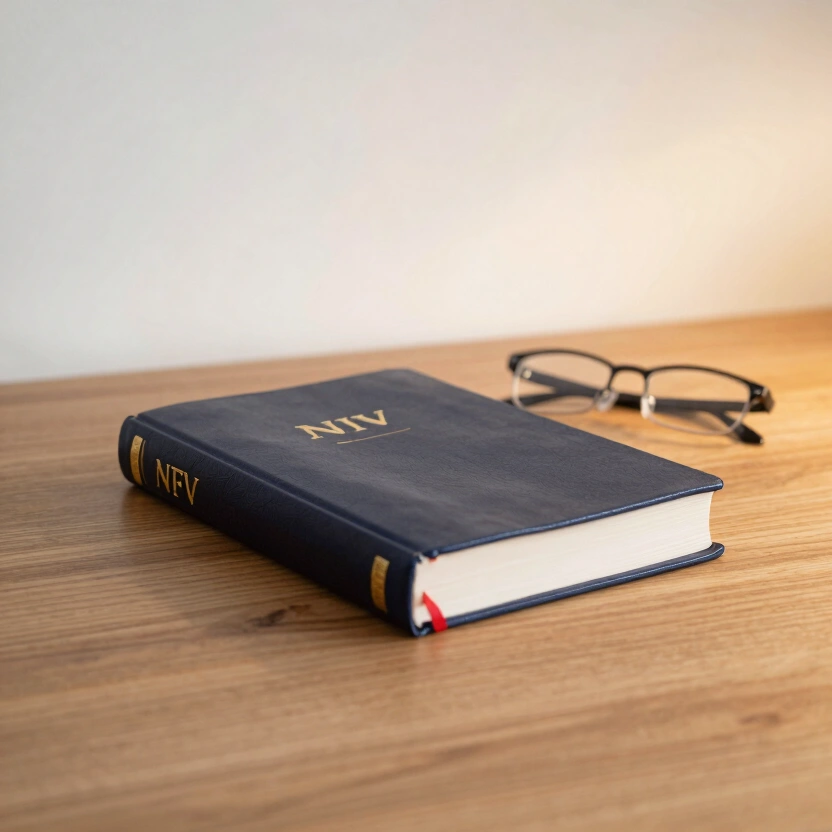
NIV Study Bible, Fully Revised Edition, Hardcover
Comprehensive study Bible with over 20,000 notes, book introductions, and full-color maps.
Check Price on AmazonAs an affiliate, we earn on qualifying purchases.

ESV Study Bible, Large Print
Large-print ESV study Bible with 20,000+ notes, charts, and theological articles.
Check Price on AmazonAs an affiliate, we earn on qualifying purchases.

Be Strong and Courageous Farmhouse Wall Sign
Large farmhouse-style wooden sign with Joshua 1:9 verse, distressed finish for rustic home decor.
Check Price on AmazonAs an affiliate, we earn on qualifying purchases.
Thomas — The Disciple Who Doubted and What Jesus Did About It
“Unless I see the nail marks in his hands and put my finger where the nails were, and put my hand into his side, I will not believe.” — John 20:25 (NIV)
Thomas gets a bad reputation. “Doubting Thomas” has become shorthand for weak faith. But look at the man before this moment.
In John 11:16, when Jesus decides to return to Judea where people have tried to stone him, it is Thomas who says to the other disciples: “Let us also go, that we may die with him.” That is not a coward. That is a man of fierce loyalty who commits fully or not at all. His doubt after the resurrection is inseparable from his character — this is someone who needs to see because he is unwilling to commit halfway.
Thomas was not present at the first post-resurrection appearance. We do not know why — John does not tell us. He was working from different information than the other ten. He had not doubted lazily. He had simply not been in the room.
Eight days later, Jesus entered the locked room. Not with rebuke. With “Peace be with you” — the same greeting he had given the others the week before. Then he addressed Thomas’s specific conditions directly: “Put your finger here; see my hands. Reach out your hand and put it into my side. Stop doubting and believe.” The text does not say Thomas actually touched the wounds. The seeing was enough.
What came next was the most direct declaration of Jesus’ identity in any Gospel: “My Lord and my God!” The man whose doubt is most famous is also the man whose confession is most complete. That is not coincidence.
C.S. Lewis described his own conversion in Surprised by Joy as slow, reluctant, and reasoned — a process closer to Thomas than to a sudden flash. Thomas is the patron saint of every person who needs to see before they can believe. And Jesus met that need without shaming it.
Four More Verses That Have Carried People Through Doubt
Proverbs 3:5-6 — “Trust in the Lord with all your heart and lean not on your own understanding; in all your ways submit to him, and he will make your paths straight.” Solomon writing to a son — practical instruction, not abstract theology. “Lean not on your own understanding” is not anti-intellectual. It is a warning against trusting the conclusions of a limited vantage point. When doubt feels like your reasoning against God, trust reframes it as your reasoning within God’s larger view.
Hebrews 11:1 — “Now faith is confidence in what we hope for and assurance about what we do not see.” Every figure in the Hall of Faith — Abraham, Moses, Rahab — acted before the outcome was visible. Faith in Hebrews is not the absence of uncertainty. It is movement in the presence of it. If bible verses for anxiety speak more directly to what you are carrying, start there — anxiety and doubt often share the same root but need different words.
Isaiah 43:1 — “Do not fear, for I have redeemed you; I have summoned you by name; you are mine.” Written to exiles — people who had genuine reason to believe God had abandoned them. The certainty of “you are mine” is directed at people in the theological equivalent of a dark room. It does not explain why the room is dark. It says who is in it with them.
Romans 8:38-39 — “For I am convinced that neither death nor life, neither angels nor demons, neither the present nor the future… will be able to separate us from the love of God.” Paul’s word pepeismai means “I have been persuaded and remain persuaded.” Not a snap decision. A hard-won conviction. Paul arrived at this certainty through beatings, shipwrecks, and prison — not through the absence of faith but through the presence of something that outlasted his doubt.

The question at three in the morning does not go away because you read an article. It may not go away for a long time. But the people who wrote these bible verses about doubt — David in his cave, Asaph at his instrument, the father on his knees in front of Jesus, Thomas in that locked room — were not people who never doubted. They were people who brought the doubt somewhere instead of carrying it alone.
Mark 9:24 remains the most honest prayer anyone has ever prayed: I believe; help me overcome my unbelief. It does not resolve the tension. It names it. And in the naming, something shifts — because the prayer is no longer about having enough faith. It is about having enough honesty. The father’s son was healed not because the father believed perfectly, but because he brought the imperfect belief to the right person.
That is what these verses offer. Not an answer to the question at three in the morning. A place to bring it.
Frequently Asked Questions
Is doubt a sin according to the Bible?
The Bible does not treat doubt as a moral failure the way it treats sin. The Psalms are filled with writers who openly question God — and are never rebuked for it. The distinction Scripture draws is between honest wrestling (diakrino — the wavering that still contains belief) and settled, deliberate rejection (apistia — turning away entirely). Thomas doubted and was met with evidence, not punishment. The father in Mark 9 confessed doubt and his son was healed. Doubt that drives you toward God is categorically different from unbelief that turns away.
What are the best bible verses about doubt to memorize?
Mark 9:24 is the most honest starting point — “I do believe; help me overcome my unbelief.” Psalm 13:1-2 gives language for lament when God feels absent. Proverbs 3:5-6 offers a daily practice for seasons when understanding fails. And Romans 8:38-39 is the anchor verse for long-term doubt — Paul’s hard-won conviction that nothing separates you from God’s love, including your own uncertainty.
Did any major figures in the Bible struggle with doubt?
Yes — and not minor characters. Thomas (John 20:24-29) refused to believe in the resurrection without physical evidence. David asked “How long, Lord? Will you forget me forever?” (Psalm 13:1). Asaph, a worship leader, asked “Has God forgotten to be gracious?” (Psalm 77:9). John the Baptist — the man who baptized Jesus — sent messengers from prison asking, “Are you the one who is to come, or should we expect someone else?” (Matthew 11:3). Doubt in the biblical narrative is a mark of genuine engagement, not absence of faith.
What is the difference between doubt and unbelief?
The New Testament uses different Greek words for them. Diakrino — doubt — means to judge in two directions, to waver between possibilities. It contains belief as one of its components. You cannot doubt what you have already discarded. Apistia — unbelief — in its strongest usage is a settled orientation away from God, not a wavering one. Most people who call what they are experiencing “doubt” are in diakrino territory. They are still in the room, still searching, still asking. That is a very different place than having left.
Related Articles
- Bible Verses for Anxiety: Finding Calm When Your Mind Won’t Stop
- Bible Verses About Faith: 15 Scriptures for Every Season of Belief
- Bible Verses About Trust When Everything Feels Uncertain
- Bible Verses About Depression and the God Who Draws Near
- Bible Verses for Hard Times That Carried Real People Through
Related Articles

Bible Verses About Patience: 14 Scriptures for the Wait
14 bible verses about patience with the history and original language — from people who waited years, decades, and lifetimes and didn't quit.

Bible Verses About Trust When Everything Feels Uncertain
These bible verses about trust were written by people who had real reasons not to trust — exiles, prisoners, kings running for their lives. Here's the history and language behind each one.
Bible Verses About Prayer and How God Hears You
The Bible has more to say about prayer than almost any other topic. Here are 9 key verses — with the history, original language, and real people who prayed them.