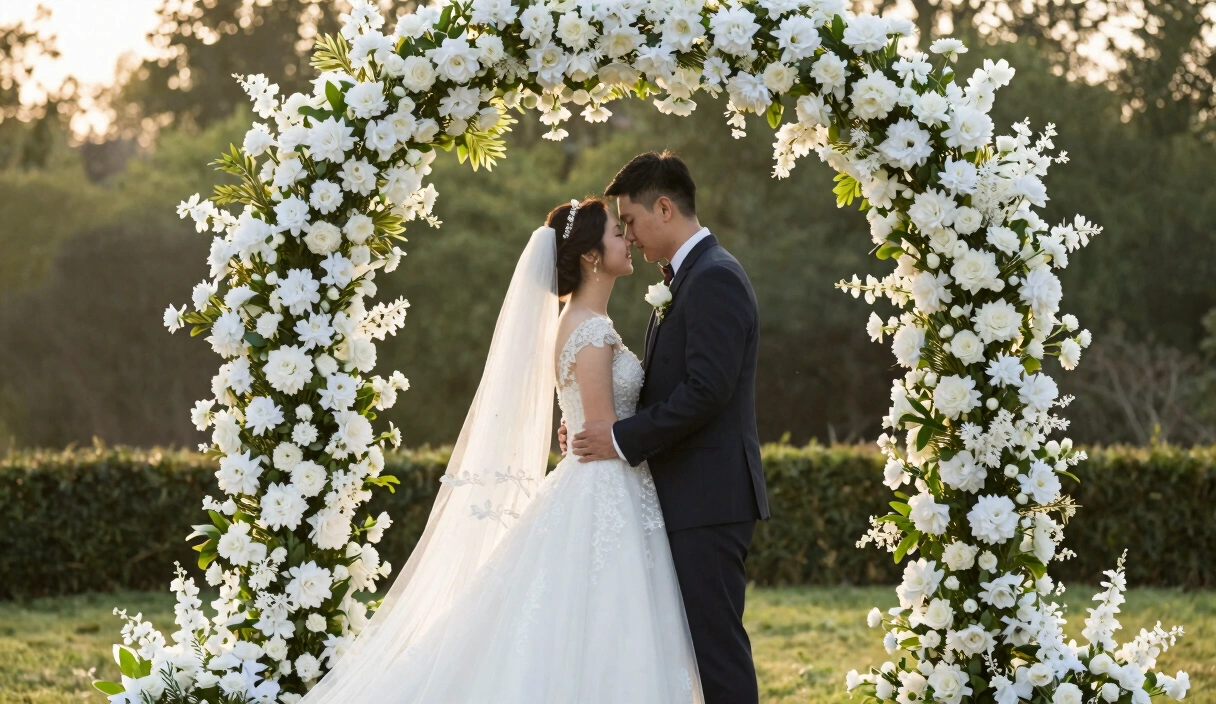
Bible Verses for Weddings: 14 Scriptures for the Ceremony and Beyond
14 bible verses for weddings with the history and original language — for vows, readings, toasts, and the marriage that starts after the ceremony ends.
Contents
Ancient Jewish weddings lasted seven days. The groom’s family hosted. The wine had better not run out (it did once — John 2 — and Jesus had to fix it). There were no vows as we know them. The marriage was sealed by a covenant — berit — a binding agreement between families, witnessed by the community and officiated under a canopy called a chuppah. The Bible verses most commonly read at weddings today were never written for wedding ceremonies. 1 Corinthians 13 was written to a dysfunctional church. Ecclesiastes 4:12 was written about business partnerships. Genesis 2:24 was written about the creation of humanity.
That doesn’t make them wrong for weddings. It makes them better. Because the truths they describe about love, commitment, and partnership are so fundamental that they apply to every covenant relationship — including the one you’re about to make.
The Ceremony Readings
1 Corinthians 13:4-8
“Love is patient, love is kind. It does not envy, it does not boast, it is not proud. It does not dishonor others, it is not self-seeking, it is not easily angered, it keeps no record of wrongs. Love does not delight in evil but rejoices with the truth. It always protects, always trusts, always hopes, always perseveres. Love never fails.”
The most read wedding passage in the English-speaking world — and Paul wrote it to a church tearing itself apart over spiritual gifts, social status, and party loyalty. He wasn’t describing romantic love. He was describing agape — the love that acts regardless of feeling, that persists when the other person doesn’t deserve it, that keeps no ledger of wrongs even when the wrongs are real.
Every verb in this passage is active. Love does things and refuses to do things. “Is patient” — makrothumei — is present tense, ongoing. “Keeps no record” — ou logizetai — uses accounting language, as if love tears up the receipt instead of filing it. The passage works at weddings not because it was written for them, but because the love it describes is exactly what marriage demands. For the full picture of love in Scripture, the pillar article goes deeper.
Genesis 2:24
“That is why a man leaves his father and mother and is united to his wife, and they become one flesh.”
The oldest statement about marriage in the Bible — and the author’s editorial comment on Adam and Eve’s union. “United” — davaq — means to cling, to stick, to bond permanently. The word is used elsewhere for glue — something that holds two surfaces together and resists separation. “One flesh” — basar echad — describes a unity that encompasses body, life, purpose, and identity. Not the erasure of individuality. The fusion of two lives into one shared direction.
And the sequence matters: leave, then unite. The marriage requires a departure first. Not cutting off family — but establishing that the new bond takes priority. For how the Bible’s marriage theology develops from this verse, that article builds the full picture.
Song of Solomon 8:6-7
“Place me like a seal over your heart, like a seal on your arm; for love is as strong as death, its jealousy unyielding as the grave. It burns like blazing fire, like a mighty flame. Many waters cannot quench love; rivers cannot sweep it away.”
The most intense love poetry in the Bible. “Strong as death” — azzah kamavet — is a comparison to the one force no human being has ever defeated. The Shulamite woman claims love matches death in power. And “many waters cannot quench” — the language of a flood that fails to extinguish a fire. Love in this passage isn’t tender. It’s volcanic. Undrenchable. For a wedding ceremony, it raises the stakes: this isn’t a gentle commitment. It’s something fierce.
Ecclesiastes 4:9-12
“Two are better than one, because they have a good return for their labor… A cord of three strands is not quickly broken.”
The Teacher — pragmatic as always. The argument for partnership is practical: shared labor produces better results. If one falls, the other lifts. If one is cold, the other warms. And “a cord of three strands” has been interpreted in Christian weddings as husband, wife, and God — the third strand that reinforces the bond. The Hebrew meshulash — “threefold” — means tripled in strength. The marriage that includes God isn’t twice as strong. It’s three times.
For the Vows
Ruth 1:16-17
“Where you go I will go, and where you stay I will stay. Your people will be my people and your God my God. Where you die I will die, and there I will be buried.”
Ruth to Naomi — her mother-in-law, not a spouse. But the words have migrated into wedding vows across centuries because they express total commitment without reservation. “Where you go” — el asher telkhi elekh — no conditions. No “as long as it’s comfortable” or “if it makes sense for my career.” The commitment is geographic, relational, spiritual, and mortal. Ruth pledged to share Naomi’s home, community, God, and grave. Wedding vows modeled on this carry the same weight.
Colossians 3:14
“And over all these virtues put on love, which binds them all together in perfect unity.”
Paul naming love as the outer garment — worn over compassion, kindness, humility, gentleness, and patience (verse 12). “Binds together in perfect unity” — sundesmos tes teleiotetos — love as the belt that holds the other virtues in place. Without love, kindness drifts into people-pleasing, patience curdles into resentment, humility becomes self-erasure. Love holds them in their proper shape. In a marriage, love is the organizing principle that keeps every other virtue from deforming.
Ephesians 4:2-3
“Be completely humble and gentle; be patient, bearing with one another in love. Make every effort to keep the unity of the Spirit through the bond of peace.”
Paul to the church — but the instruction is marriage-ready. “Bearing with” — anechomai — means to hold up, to carry weight. Every marriage requires carrying something — the other person’s habits, weaknesses, moods, bad days. “Make every effort” — spoudazontes — means to be zealous about, to pursue actively. Unity doesn’t maintain itself. It requires daily effort.
Recommended Resources

XKDOUS Bible Verses Jar Kit — 270 Selected Verses
Jar with 270 hand-selected Bible verses for daily encouragement — ideal as a Christian graduation or friendship gift.
Check Price on AmazonAs an affiliate, we earn on qualifying purchases.

Be Strong and Courageous Farmhouse Wall Sign
Large farmhouse-style wooden sign with Joshua 1:9 verse, distressed finish for rustic home decor.
Check Price on AmazonAs an affiliate, we earn on qualifying purchases.
NIV Beautiful Word Bible
Full-color illustrated Bible with 500+ hand-lettered verses for creative journaling and reflection.
Check Price on AmazonAs an affiliate, we earn on qualifying purchases.

For Toasts and Blessings
Numbers 6:24-26
“The Lord bless you and keep you; the Lord make his face shine on you and be gracious to you; the Lord turn his face toward you and give you peace.”
The Aaronic blessing — the oldest blessing still spoken in synagogues and churches worldwide. Three lines, each building on the last: bless, shine, peace. “Make his face shine” — ya’er panav — describes the warmth of someone looking at you with full attention and delight. Used at a wedding, it’s a prayer that God would look at this couple the way he looked at creation — and call it good.
Jeremiah 29:11
"‘For I know the plans I have for you,’ declares the Lord, ‘plans to prosper you and not to harm you, plans to give you hope and a future.’"
Often used in toasts and blessings — the promise of God’s trajectory. The Hebrew shalom (translated “prosper”) means wholeness, and acharit (“future”) means the final destination. For a couple starting a life together, the verse offers assurance that God has an endpoint in mind for their shared story — and it’s characterized by completeness, not harm. For the full context that changes how most people read this verse, that article explains what was actually happening when Jeremiah wrote it.
Philippians 1:9-11
“And this is my prayer: that your love may abound more and more in knowledge and depth of insight, so that you may be able to discern what is best and may be pure and blameless for the day of Christ.”
Paul praying for the Philippians — and the prayer works beautifully at a wedding. “Love may abound more and more” — mallon kai mallon — excess upon excess. Paul’s prayer for love isn’t that it would be sufficient. It’s that it would be excessive, overflowing, beyond what’s needed. And “in knowledge and depth of insight” — love that grows smarter over time. Not just more intense. More perceptive. Love that learns the other person better each year.
Wedding verses carry weight that reaches far past the ceremony. The vows made on one day will be tested on a thousand ordinary days that follow — and the Scripture read at the altar has a way of surfacing again in the kitchen, in the hospital, in the argument at midnight, in the reconciliation the next morning. The best wedding verses aren’t the ones that make people cry at the ceremony. They’re the ones that hold the marriage together on the days nobody’s watching.
If what you need alongside wedding planning is a broader view of biblical love, the pillar article covers every dimension. And if marriage as a lifelong covenant is what you’re exploring — what it actually means after the ceremony — that article gets into the daily texture.

Related Articles
Frequently Asked Questions
What is the most popular Bible verse for weddings?
1 Corinthians 13:4-8 is the most commonly read passage at wedding ceremonies — “Love is patient, love is kind.” Genesis 2:24 — “the two become one flesh” — is the foundational marriage verse. Ruth 1:16 — “Where you go I will go” — is frequently adapted for vows. All three work in ceremonies, programs, and invitations.
Can you use Song of Solomon at a wedding?
Yes. Song of Solomon 8:6-7 is one of the most intense love declarations in Scripture — “love is as strong as death… many waters cannot quench love.” Song of Solomon 2:16 — “My beloved is mine and I am his” — is shorter and works well for programs or vow inserts. The book is a celebration of romantic love, and its language is written for exactly this kind of occasion.
What Bible verse is good for a wedding toast?
Numbers 6:24-26 (the Aaronic blessing) is the most traditional: “The Lord bless you and keep you.” Philippians 1:9-11 works well as a prayer-toast: “that your love may abound more and more.” Ecclesiastes 4:12 — “a cord of three strands is not quickly broken” — is brief and memorable. For something more personal, 3 John 1:4 — “I have no greater joy than to hear that my children are walking in the truth” — works for a parent’s toast.
Related Articles

Bible Verses About Marriage: God's Design for Husband and Wife
15 bible verses about marriage with the history, original language, and context — for couples building something, not just keeping it together.

Bible Verses About Love: 18 Scriptures With Context and Meaning
These 18 Bible verses about love come with the context, history, and meaning behind each one — so the words actually reach you where you are.

1 Corinthians 13 Meaning: What Love Really Looks Like
1 Corinthians 13 is called the love chapter — but Paul wrote it to a church tearing itself apart. Here's what these famous words actually meant, verse by verse, and why the context makes them harder and better.