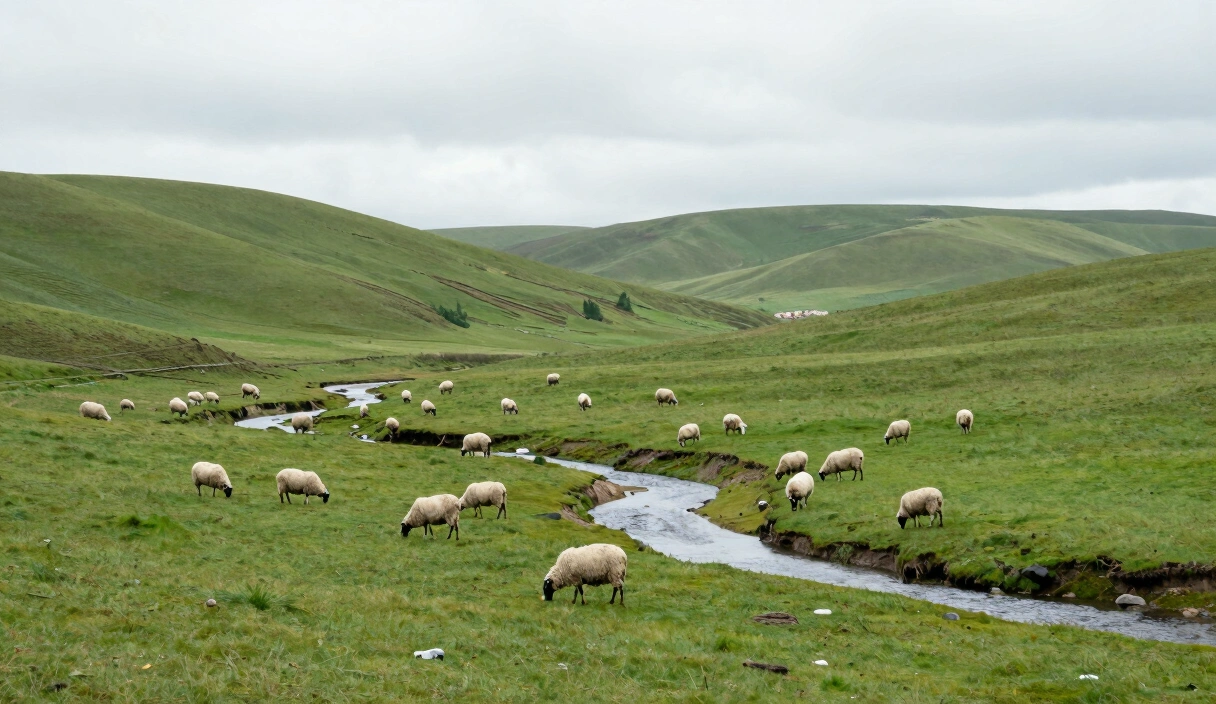
Psalm 23 Meaning: What 'The Lord Is My Shepherd' Actually Says
Psalm 23 is the most memorized chapter in the Bible. Here's what each line meant when David wrote it, what the Hebrew reveals, and why a shepherd metaphor holds more than most people realize.
Contents
You probably know Psalm 23 by heart. Or close to it. Most people who grew up in a church can start it from memory — “The Lord is my shepherd, I shall not want” — and get at least four verses deep before the words blur. It’s read at nearly every funeral. It’s on more wall art than any other psalm. It’s been set to music hundreds of times. And all that familiarity has done something unfortunate: it’s made the psalm feel gentle, decorative, safe.
It isn’t. David was a shepherd. He knew what the job actually involved — killing predators with his bare hands, searching for lost animals in terrain that could break your ankle, sleeping outside in weather that didn’t care about him. When David called God his shepherd, he wasn’t reaching for a soft metaphor. He was describing the most protective, most dangerous, most hands-on role he knew.
Verse by Verse
Verse 1: “The Lord is my shepherd, I lack nothing.”
Adonai ro’i, lo echsar. Six words in Hebrew. A complete theology.
“Shepherd” — ro’i — describes someone who feeds, guides, protects, and takes responsibility for the survival of creatures that cannot survive alone. Sheep are spectacularly vulnerable animals. They can’t defend themselves. They can’t navigate well. They fall into ravines. They eat poisonous plants. A flock without a shepherd is a flock dying in slow motion. David is saying: without God, that’s me.
“I lack nothing” — lo echsar — I am not deficient. The claim isn’t luxury. It’s sufficiency. Everything I need, I have. Not everything I want. Everything I need. The distinction matters — David spent years in the wilderness with very little. He wasn’t rich when he wrote this. But he lacked nothing essential.
Verse 2: “He makes me lie down in green pastures, he leads me beside quiet waters.”
Bine’ot deshe yarbitseini, al mei menuchot yenahaleini.
“Makes me lie down” — yarbitseini — the verb is causative. The shepherd causes the sheep to lie down. Sheep don’t lie down when they’re anxious, hungry, or in conflict with other sheep. The shepherd has to handle all four conditions before rest is possible. God doesn’t just offer rest. He creates the conditions for it.
“Green pastures” — ne’ot deshe — pastures of tender grass. In the arid landscape of Israel, green pasture is rare and valuable. The shepherd knows where it grows. “Quiet waters” — mei menuchot — waters of rest. Not a rushing river (which sheep avoid — they can’t swim and their wool gets waterlogged). Still pools. Safe water. The shepherd leads to places where refreshment doesn’t involve risk.
Verse 3: “He refreshes my soul. He guides me along the right paths for his name’s sake.”
Nafshi yeshovev, yancheini bema’agelei tsedeq lema’an shemo.
“Refreshes my soul” — nafshi yeshovev — literally “he restores my life.” Nefesh isn’t just “soul” in the spiritual sense. It means the whole self — vitality, energy, will to live. When a sheep collapses from exhaustion, the shepherd lifts it, carries it, and revives it. David is describing what God does when you’re spent.
“For his name’s sake” — lema’an shemo. God guides you along right paths not because you deserve it but because his reputation is at stake. A shepherd’s honor depends on the condition of his flock. Thin, injured, lost sheep reflect poorly on the shepherd. God’s investment in your well-being is connected to his character. He leads you well because he is good — not because you earned it.
Verse 4: “Even though I walk through the darkest valley, I will fear no evil, for you are with me; your rod and your staff, they comfort me.”
Gam ki elekh bege tsalmaveth, lo ira ra, ki attah immadi. Shivteka umishanteka hemmah yenachamuni.
This is the center of the psalm — structurally and emotionally. And something shifts. David stops talking about God in third person (“he”) and switches to second person (“you”). When the darkness comes, God stops being “he” and becomes “you.” The relationship moves from description to direct address. In the worst moment, David speaks to God, not about him.
“Darkest valley” — tsalmaveth — has traditionally been translated “shadow of death.” The word combines tsel (shadow) and maveth (death). Whether it means literal death or the deepest possible darkness, the image is the same: a place where light fails and visibility drops to nothing. And “I will fear no evil” — not “there is no evil.” The evil is real. The valley is real. But the fear doesn’t control because “you are with me.”
“Rod and staff” — shevet and mishenet. The rod (shevet) was a heavy club used to fight predators — wolves, bears, thieves. The staff (mishenet) was the long crook used to guide and rescue sheep. One weapon. One tool. Together they represent both protection and guidance. God fights what threatens you and redirects you when you wander. Both actions comfort.
Verse 5: “You prepare a table before me in the presence of my enemies. You anoint my head with oil; my cup overflows.”
Ta’arokh lefanai shulchan neged tsorerai. Dishanta vashemen roshi, kosi revayah.
The metaphor shifts from shepherd to host. In ancient Near Eastern culture, hospitality was sacred — a host was bound to protect any guest at their table, even from enemies. “In the presence of my enemies” — the table is set where the threats are visible. God doesn’t remove the enemies. He feeds you in front of them. The provision is public. The protection is demonstrative.
“Anoint my head with oil” — dishanta vashemen roshi. Olive oil was applied to guests as a sign of honor and welcome. The host massages oil into the guest’s head — an intimate, honoring act. “My cup overflows” — kosi revayah — the cup runs over. Not measured. Not rationed. Excessive. God’s provision isn’t calculated to sufficiency. It exceeds it.
Verse 6: “Surely goodness and love will follow me all the days of my life, and I will dwell in the house of the Lord forever.”
Akh tov vachesed yirdefuni kol yemei chayyai, veshavti beveit Adonai le’orekh yamim.
“Follow” — yirdefuni — is a surprising verb. It means to pursue, to chase. The same word used for enemies pursuing in battle. David is saying that God’s goodness and chesed (covenant love, faithful kindness) will hunt him down. Not gently follow at a distance. Chase. Pursue. Track him wherever he goes. The goodness is aggressive.
“Dwell in the house of the Lord” — David’s final destination. After the pastures, the valleys, the table, the enemies — the psalm ends at home. Beveit Adonai — in God’s house. And “forever” — le’orekh yamim — literally “for length of days.” The psalm that began with present provision ends with permanent residence. The shepherd who guided through every terrain brings the sheep home.
Recommended Resources
NIV Study Bible, Fully Revised Edition, Hardcover
Comprehensive study Bible with over 20,000 notes, book introductions, and full-color maps.
Check Price on AmazonAs an affiliate, we earn on qualifying purchases.
ESV Study Bible, Large Print
Large-print ESV study Bible with 20,000+ notes, charts, and theological articles.
Check Price on AmazonAs an affiliate, we earn on qualifying purchases.

XKDOUS Bible Verses Jar Kit — 270 Selected Verses
Jar with 270 hand-selected Bible verses for daily encouragement — ideal as a Christian graduation or friendship gift.
Check Price on AmazonAs an affiliate, we earn on qualifying purchases.
What Most People Miss
David Wasn’t Writing from Comfort
The psalm reads like someone settled and safe. But David’s life was the opposite — years as a fugitive, a civil war with his own son, the death of his infant child, military campaigns that left him exhausted. The psalm isn’t a reflection from a comfortable chair. It’s a declaration made against evidence. David chose to call God his shepherd while his life looked nothing like green pastures.
The Psalm Is Structured Around Absence
Notice what the psalm lacks: there’s no request. No petition. No “please, God, do this.” Every other psalm of David contains a request. This one doesn’t. It’s pure declaration — a statement of what is already true. The confidence is past-tense: God has fed me, has guided me, has protected me. The future tense comes only at the end: goodness will follow, I will dwell. The psalm’s confidence comes from experience, not hope alone.
Sheep Are Not a Flattering Metaphor
David isn’t complimenting the reader by calling them a sheep. Sheep are directionless, defenseless, and prone to walking off cliffs. They require constant supervision. They can’t find their own food in unfamiliar terrain. Calling yourself a sheep is an admission of dependence — “I cannot do this alone.” The psalm’s beauty comes from the marriage of that honest vulnerability with the certainty that the shepherd is competent.
Psalm 23 works at funerals because verse 4 walks through death’s shadow. It works in hospitals because verse 3 promises soul-restoration. It works on ordinary Tuesdays because verse 1 covers everything else: whatever today holds, I lack nothing. The psalm fits everywhere because the shepherd metaphor covers everything — provision, guidance, protection, comfort, presence, and home.
For how Psalm 23 sits alongside the most-searched passages in the Bible, the pillar article traces the pattern. If comfort is specifically what you need right now — not analysis, but presence — that collection gathers the verses for the heaviest moments. And if you’re carrying something that needs more than comfort — something that needs healing — the pillar article addresses the full scope.

Frequently Asked Questions
What does Psalm 23 mean?
Psalm 23 is David’s declaration that God provides, guides, and protects like a shepherd caring for sheep. It moves through six stages: provision (verses 1-2), restoration (verse 3), protection in darkness (verse 4), honor in the presence of enemies (verse 5), and a permanent home with God (verse 6). The psalm’s power comes from David’s vulnerability — calling himself a sheep is admitting total dependence on God.
What does “valley of the shadow of death” mean?
The Hebrew tsalmaveth combines tsel (shadow) and maveth (death). It describes the deepest possible darkness — whether literal dying, grief, depression, or any life situation where light has failed. The key detail: the psalmist walks through the valley, not into a dead end. The preposition implies passage, not permanent residence. And God’s presence — “you are with me” — is what makes the passage survivable.
Why is Psalm 23 read at funerals?
Verse 4 directly addresses death — “even though I walk through the valley of the shadow of death, I will fear no evil.” The psalm promises God’s presence in humanity’s most feared moment. Verse 6 promises “dwelling in the house of the Lord forever,” offering hope beyond death. And the pastoral imagery — green pastures, quiet waters, overflowing cups — provides comfort and peace. The combination makes Psalm 23 the most read passage at funerals across nearly every Christian tradition.
Who wrote Psalm 23 and when?
David wrote Psalm 23 — it’s attributed to him in the superscription. David was a literal shepherd before becoming king of Israel (1 Samuel 16:11), which gave the metaphor personal depth. The exact date is unknown, but the psalm’s confident tone suggests David wrote it later in life, reflecting on God’s faithfulness across decades of danger, war, loss, and eventual kingship.
Related Articles

Psalm 91 Meaning: What 'Under the Shadow of the Almighty' Promises
Psalm 91 is the Bible's strongest protection psalm — and the one Satan quoted to Jesus. Here's what it promises, what it doesn't, and why the original context matters more than the bumper sticker.

Bible Verses for Grief: 15 Scriptures for the Loss You're Carrying
15 bible verses for grief with the history and original language — written by people who buried loved ones, watched kingdoms fall, and found God hadn't left the room.

Bible Verses About Death That Speak to What We're All Afraid Of
8 bible verses about death — with the Hebrew and Greek behind them, the people who wrote them under unbearable loss, and what Scripture promises about what comes next.