
NIV vs ESV: Which Bible Translation Should You Actually Read?
NIV vs ESV compared side by side — readability, accuracy, philosophy, and which one works better for study, devotion, and memorization. Honest breakdown from someone who uses both.
Contents
The question isn’t really “which translation is better?” Both are solid. Both are used by millions. Both have teams of scholars behind them. The real question is: what are you using it for? Because the NIV and ESV made fundamentally different choices about translation philosophy, and those choices show up every time you open the page. If you’re reading devotionally, one feels more natural. If you’re studying word-by-word, the other gives you more to work with. If you’re memorizing, one sticks in the brain differently than the other.
I’ve read the ESV for years. I switch to the NIV when I’m reading aloud or sharing a verse with someone who doesn’t have a church background. Both sit on my shelf. Both are underlined. The honest answer is: you’ll probably end up using both. But here’s how to know which one to start with.
Translation Philosophy: The Core Difference
ESV: Word-for-Word (Formal Equivalence)
The English Standard Version tries to translate each Hebrew or Greek word into its closest English equivalent, preserving the sentence structure of the original where possible. This means the ESV often sounds more literary, more “Bible-like,” and sometimes less natural in English. You’re reading closer to what the original says, but you’re also reading sentences that an English writer wouldn’t naturally construct.
Example — Romans 12:2:
ESV: “Do not be conformed to this world, but be transformed by the renewal of your mind.”
The phrasing “renewal of your mind” is a direct translation of anakainosis tou noos. It’s precise. It’s also slightly formal — you wouldn’t say “renewal of my mind” in conversation.
NIV: Thought-for-Thought (Dynamic Equivalence)
The New International Version translates ideas rather than individual words. When a Hebrew idiom would confuse an English reader, the NIV translates the meaning behind the idiom rather than the literal words. This makes the NIV smoother, more readable, and sometimes more interpretive — because the translators made choices about what the original meant, not just what it said.
Example — Romans 12:2:
NIV: “Do not conform to the pattern of this world, but be transformed by the renewing of your mind.”
“Pattern of this world” is interpretation — the Greek says aion, which means “age” or “era,” not “pattern.” The NIV made a judgment call about what Paul meant. The result reads more naturally. Whether that interpretive step helps or hurts depends on what you need.
Side-by-Side Comparisons
The differences between the NIV and ESV are rarely dramatic. But they accumulate, and certain passages show the gap clearly.
Psalm 23:1
ESV: “The Lord is my shepherd; I shall not want.” NIV: “The Lord is my shepherd, I lack nothing.”
Both are accurate. The ESV preserves the traditional phrasing from the KJV era — “I shall not want.” The NIV translates the underlying meaning: “I lack nothing.” A younger reader or a non-native English speaker will understand the NIV immediately. The ESV carries the weight of four centuries of English Bible tradition.
Philippians 4:13
ESV: “I can do all things through him who strengthens me.” NIV: “I can do all this through him who gives me strength.”
“All things” (ESV) is the literal Greek panta. “All this” (NIV) is an interpretive choice — the NIV translators decided Paul was referring to the specific circumstances he described in verses 11-12 (contentment in poverty and abundance), not making a universal claim. The NIV’s choice is arguably more contextually accurate. The ESV’s choice gives you the raw word and lets you decide.
Genesis 1:2
ESV: “The earth was without form and void.” NIV: “Now the earth was formless and empty.”
“Without form and void” (ESV) preserves the Hebrew pair tohu vavohu — ancient, poetic, strange-sounding. “Formless and empty” (NIV) communicates the same idea in modern English. Neither is wrong. One sounds like Scripture. The other sounds like communication. Which one you prefer tells you something about what you want from a Bible.
Isaiah 7:14
ESV: “Behold, the virgin shall conceive and bear a son.” NIV: “The virgin will conceive and give birth to a son.”
“Behold” (ESV) preserves the Hebrew hinneh — an attention-grabbing particle. The NIV drops it entirely. “Give birth to” (NIV) is natural English. “Bear” (ESV) is formal. Both translate the controversial almah as “virgin” — the major translation debate here isn’t between ESV and NIV but between all English Bibles and what the Hebrew word actually covers (young woman vs. virgin).
Recommended Resources

NIV Study Bible, Fully Revised Edition, Hardcover
Comprehensive study Bible with over 20,000 notes, book introductions, and full-color maps.
Check Price on AmazonAs an affiliate, we earn on qualifying purchases.
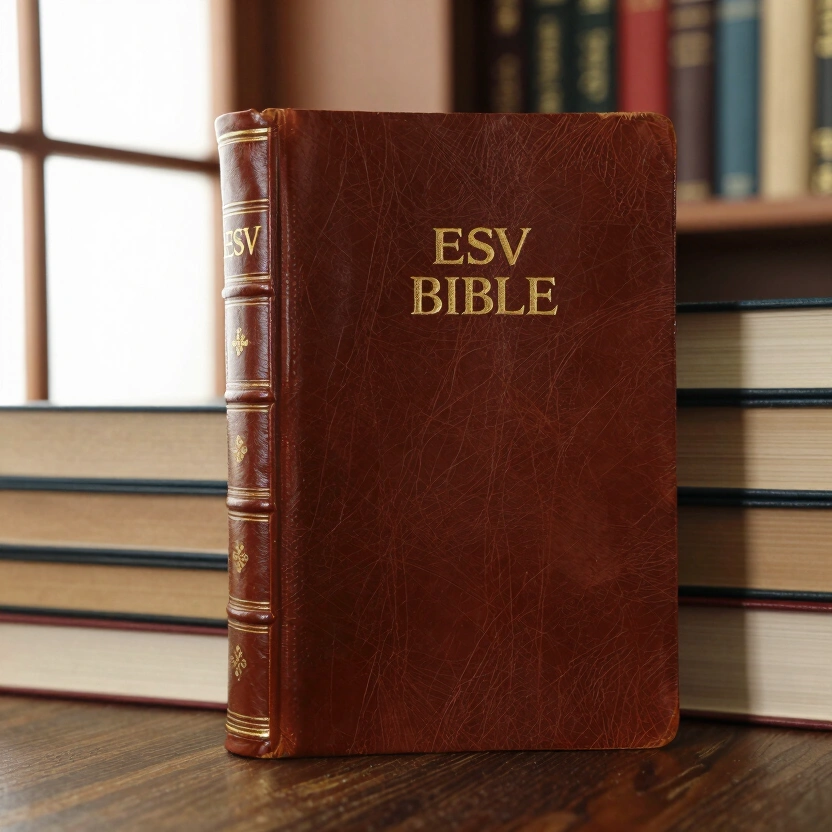
ESV Study Bible, Large Print
Large-print ESV study Bible with 20,000+ notes, charts, and theological articles.
Check Price on AmazonAs an affiliate, we earn on qualifying purchases.
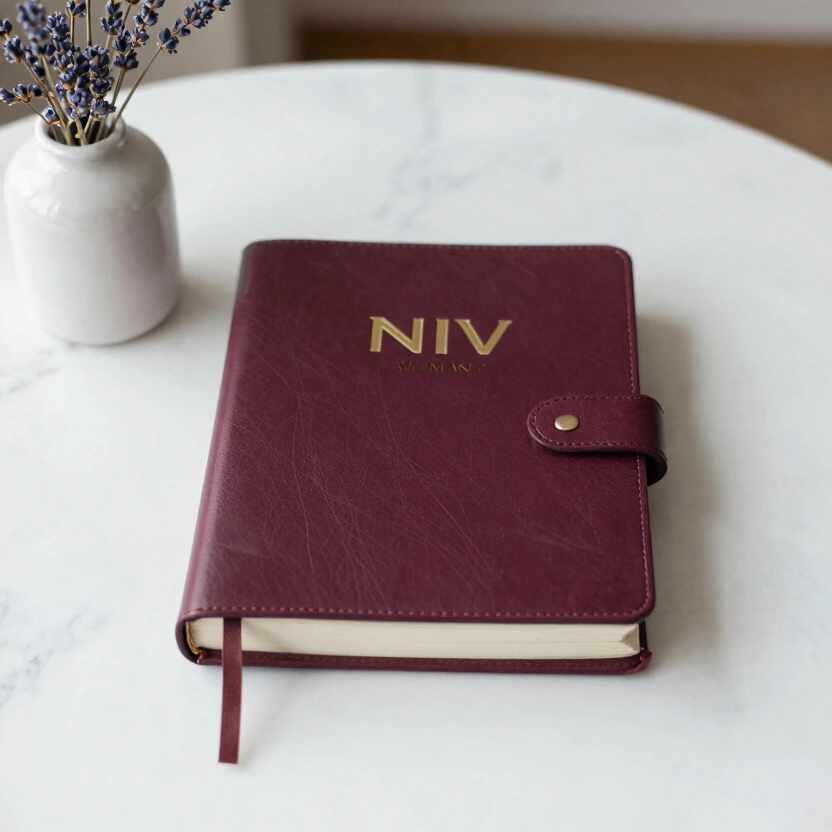
NIV The Woman's Study Bible
Study Bible designed for women with character profiles, topical articles, and devotional insights.
Check Price on AmazonAs an affiliate, we earn on qualifying purchases.

Readability
The NIV reads at roughly an 8th-grade level. The ESV reads closer to 10th-grade. That gap matters more than people think. If you’re reading a chapter a day, the NIV offers less friction. If English isn’t your first language, the NIV is more accessible. If you’re reading aloud in a group, the NIV flows more naturally off the tongue.
The ESV’s longer sentences and formal constructions slow you down — which can be either a disadvantage (harder to read) or an advantage (forces you to sit with the text longer). Some people find the ESV’s formality creates a sense of reverence. Others find it creates a sense of distance.
Neither translation is hard to read. Both are easier than the KJV by a wide margin. But the NIV is noticeably smoother, and for someone picking up a Bible for the first time, that smoothness matters.
Study and Accuracy
For word study — looking up what a Greek or Hebrew term means and tracing it through Scripture — the ESV is generally more useful. Because it translates word-for-word, the same underlying term is more likely to be translated the same way throughout. The NIV, because it translates thought-for-thought, sometimes uses different English words for the same Greek or Hebrew word depending on context.
Example: The Greek word sarx (flesh) appears frequently in Paul’s letters. The ESV consistently translates it “flesh.” The NIV translates it variously as “flesh,” “sinful nature,” “human effort,” or “earthly” depending on the passage. The NIV’s choices often make the individual verse clearer. But they make it harder to trace Paul’s use of sarx as a concept across his letters.
For sermon preparation or Bible study groups, the ESV gives you more raw material to work with. For personal devotion and emotional connection, the NIV often delivers the meaning faster.

Who Uses What
ESV: Reformed and Calvinist churches (PCA, Acts 29, The Gospel Coalition), many seminary programs, John Piper, Tim Keller. The ESV Crossway Study Bible is one of the most popular study Bibles available.
NIV: Most non-denominational evangelical churches, many Baptist congregations, mainstream Christian publishing. The NIV has the largest market share of any modern English Bible translation — roughly 30% of Bibles sold in the US.
Neither choice signals denominational loyalty. Both are used across traditions. But if your church reads from one translation, using the same one at home makes memorization and group study easier.
The Bottom Line
| Category | ESV | NIV |
|---|---|---|
| Translation approach | Word-for-word | Thought-for-thought |
| Readability | 10th grade | 8th grade |
| Best for study | ✓ | |
| Best for reading aloud | ✓ | |
| Best for beginners | ✓ | |
| Best for word study | ✓ | |
| Best for memorization | Tie | Tie |
| Accuracy | Both excellent | Both excellent |
Choose the ESV if you want to stay as close to the original wording as possible, you enjoy slower and more formal language, or you plan to do word studies and trace concepts across Scripture.
Choose the NIV if you want the clearest possible communication in modern English, you’re reading aloud to others, or you’re new to the Bible and want to understand quickly.
Choose both if you’re serious about study. Reading the same passage in both translations often reveals what the original text is doing — the differences between them are where the Hebrew or Greek is doing something that English can’t quite capture in one rendering.
For a broader comparison including KJV, NLT, NASB, and The Message, that article maps the full spectrum. And if you’re trying to understand the most-searched verses in the Bible, having both translations on hand helps you see what each verse is actually saying.
Frequently Asked Questions
Is the ESV or NIV more accurate?
Both are highly accurate — translated by teams of credentialed scholars from the best available manuscripts. The ESV is more literally accurate (closer to the original word order and vocabulary). The NIV is sometimes more contextually accurate (it interprets idiomatic language for the modern reader). Neither introduces errors. They make different trade-offs between precision and clarity.
Which Bible translation do most churches use?
The NIV has the largest market share in the United States, used by most non-denominational and many Baptist churches. The ESV is the primary Bible for Reformed churches and is increasingly popular in seminary education. The KJV still holds significant usage in traditional churches. No single translation dominates across all Christian traditions.
Should I switch from NIV to ESV?
Not necessarily. If the NIV has served you well and you understand it clearly, there’s no urgent reason to switch. However, adding the ESV as a second translation for study can reveal nuances you’d miss with just one. Many serious Bible readers use the NIV for devotional reading and the ESV (or NASB) for in-depth study. You don’t have to pick one and abandon the other.
What translation did Jesus read?
Jesus read the Hebrew Scriptures (the Old Testament) in Hebrew, and likely spoke Aramaic in daily life. The Greek translation of the Old Testament — the Septuagint (LXX) — was widely used in the first century, and many New Testament authors quote from it rather than the Hebrew text. No modern English translation existed, and the question of “which translation is correct” would have been foreign to Jesus — he read the originals.
Related Articles

Best Bible Translation Compared: An Honest Guide for Real Readers
The best bible translation depends on what you need it for. This comparison covers NIV, ESV, KJV, NLT, NASB, and more — with real examples showing how they differ.

Most Popular Bible Verses: Why These 15 Scriptures Became Famous
The 15 most popular bible verses of all time — not just listed, but explained: how they became famous, what they originally meant, and why they still matter.

Jeremiah 29:11 Meaning: What 'Plans to Prosper You' Really Says
Jeremiah 29:11 is the second most searched verse in the Bible. Here's what it meant when it was written, what the original Hebrew says, and why the context makes it better.